Use a Monte Carlo trading simulator to test equity curves, run Monte Carlo simulations, analyze forex equity risk, and optimize trading strategies with data-driven decisions.
An equity curve simulator is a powerful tool for traders who want to visualize performance, manage risk, and optimize strategies. Whether you’re in forex equity trading or developing automated systems, understanding your equity curve is critical to long-term success. In this article, we’ll explore how equity curve simulation works, why it matters, and how to use it effectively.
Monte Carlo Simulation in Trading: Why It Matters
Monte Carlo simulation is a statistical technique used to model uncertainty by running thousands of randomized scenarios. In trading, a Monte Carlo simulation helps traders understand how a strategy might behave under different sequences of wins and losses, even when the overall win rate stays the same.
By using a Monte Carlo trading simulator, traders can stress-test their systems beyond historical backtests. This approach reveals hidden risks such as deep drawdowns, long losing streaks, and equity volatility that may not appear in a single backtest. For this reason, montecarlo trading has become a core method for professional risk analysis.
A trading Monte Carlo test focuses on probability, not prediction. Instead of asking “what happened before”, it answers “what could realistically happen next”.
How a Monte Carlo Trading Simulator Improves Strategy Reliability
A trading simulator based on Monte Carlo simulation reshuffles trade outcomes to create thousands of possible equity curves. Each simulation represents a different path your strategy could take in real market conditions.
This process allows traders to:
- Measure the probability of account ruin
- Identify worst-case and best-case equity curves
- Compare average returns versus maximum drawdown
- Evaluate emotional pressure caused by losing streaks
Using a Monte Carlo test in trading shifts the focus from short-term profits to long-term survivability, which is essential for consistent performance.
Monte Carlo Test vs Traditional Backtesting
Traditional backtesting follows the exact historical order of trades. While useful, it assumes the future will behave in the same sequence as the past.
A Monte Carlo simulation trading approach removes this bias by randomizing trade order. This reveals whether a strategy is robust or simply benefited from favorable trade sequencing.
In practice, a strategy that performs well in backtests but fails Monte Carlo testing is often over-optimized and fragile.
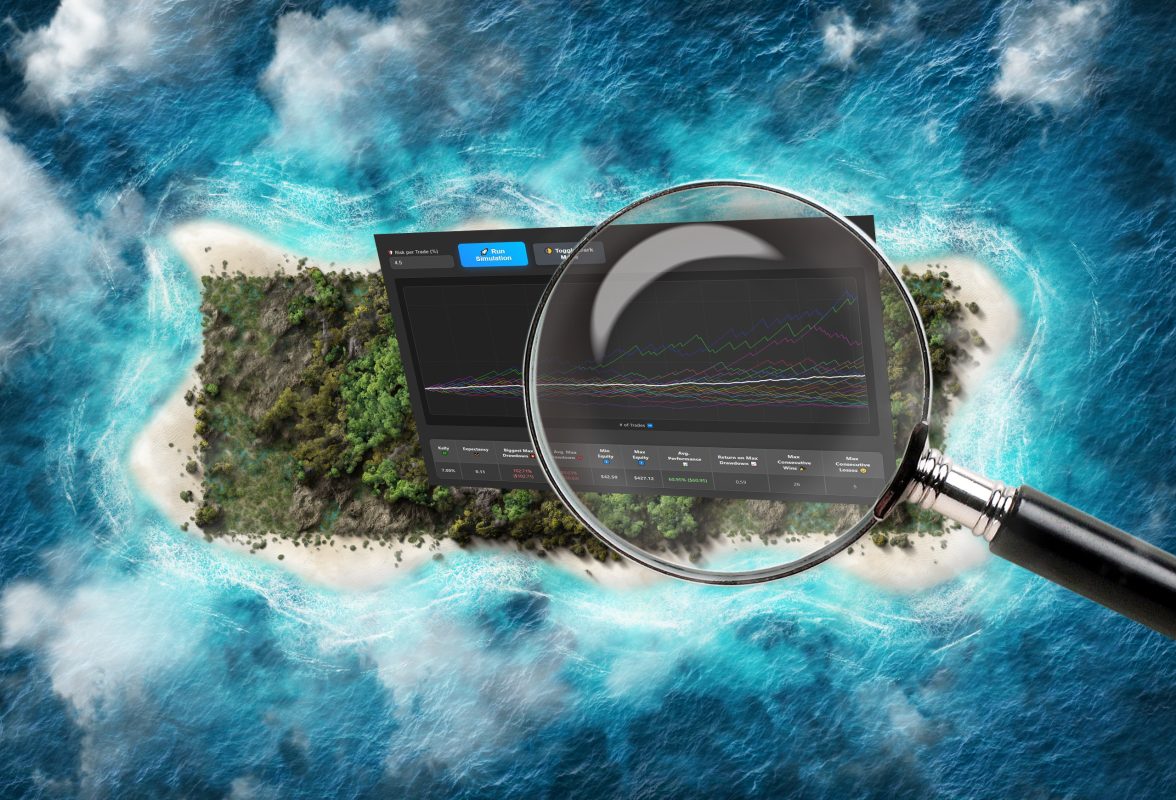
What Is an Equity Curve?
An equity curve is a graphical representation of the growth or decline of a trading account over time. It shows how a strategy performs across a series of trades and reflects real or simulated equity in the account.
- X-axis: Number of trades or time (days, weeks, etc.)
- Y-axis: Account value (balance or equity)
- The curve may rise (profit) or fall (loss), revealing volatility and risk.
Having a stable and upward-trending equity curve is a key goal for any trader, especially in equity curve trading, where decisions depend directly on curve behavior.
How Does an Equity Curve Simulator Work?
An equity curve simulator uses historical or randomly generated trade results to model the performance of a trading strategy. It allows traders to test different conditions and visualize the possible outcomes.
Key features of a modern equity curve simulator:
- Input parameters like win rate, risk/reward ratio, trade frequency
- Monte Carlo simulations to test for randomness and robustness
- Equity drawdown detection to analyze risk exposure
- Performance metrics like Kelly ratio, Sharpe ratio, and average max drawdown
- Visual output (charts, tooltips, tables) for clear analysis
Our tool even includes dark mode, chart interactivity, and customizable themes to enhance usability.
Why Use an Equity Curve Simulator or Monte Carlo Simulation?
Using an equity curve simulator isn’t just a technical exercise—it’s a necessity for serious traders. Here’s why:
1. Risk Management
Understanding potential maximum drawdowns and minimum equity helps prevent account blowouts.
2. Strategy Optimization
Testing different setups lets traders refine parameters before using real capital.
3. Psychological Preparation
Seeing potential losing streaks ahead of time prepares traders for real-world challenges.
4. Decision-Making in Equity Curve Trading
In equity curve trading, traders use rules based on the curve’s direction (e.g., pause trading during a dip) to reduce losses and protect gains.
How Is Forex Equity Related?
Forex equity refers to the real-time value of a trading account in the foreign exchange market. It’s affected by open positions, margin, and floating profits/losses.
When using an equity curve simulator, forex traders can simulate:
- Realistic pip movement and volatility
- Margin requirements and leverage
- Currency pair behavior over time
This makes equity curve simulators especially relevant for forex equity risk modeling and money management.
Tips for Using an Equity Curve Simulator Effectively and Monte Carlo Simulation
Here’s how to get the most from your simulator:
- Simulate hundreds or thousands of runs to capture randomness
- Use conservative assumptions (e.g., higher loss streaks)
- Pay attention to outliers – what’s the worst-case scenario?
- Compare different strategies side-by-side using average equity, drawdowns, and variance
- Monitor the equity curve regularly in live trading for actionable insights
Common Questions About Equity Curve Simulators
Is an Equity Curve Enough to Judge a Strategy?
No. The curve is important, but should be used alongside metrics like expectation, Sharpe ratio, and historical performance. Look at both shape and stability.
Can You Use an Equity Curve to Time the Market?
Not exactly—but in equity curve trading, many systems use the curve’s slope or drawdown levels to signal whether to continue or pause trading.
Are Equity Curve Simulators Accurate?
They’re as accurate as the assumptions you feed them. Good simulators include randomness and variability to mimic real-world unpredictability.
Frequently Asked Questions About Monte Carlo Simulation in Trading
What is a Monte Carlo simulation in trading?
A Monte Carlo simulation in trading is a method that generates thousands of randomized trade sequences to analyze possible future equity curves. It helps traders understand risk, drawdowns, and variability beyond historical results.
What is a Monte Carlo trading simulator?
A Monte Carlo trading simulator is a tool that applies Monte Carlo simulation to trading strategies. It allows traders to test equity curves, risk parameters, and money management rules under many possible market scenarios.
Why is Monte Carlo testing important for traders?
Monte Carlo testing is important because it exposes hidden risks. Even profitable strategies can experience severe drawdowns or long losing streaks. Monte Carlo simulation helps traders prepare for these scenarios before risking real capital.
Is Monte Carlo simulation better than backtesting?
Monte Carlo simulation is not a replacement for backtesting, but a complement. Backtesting shows what happened in the past, while Monte Carlo simulation shows what could happen in the future under uncertainty.
How many simulations are needed for a reliable Monte Carlo test?
Most trading Monte Carlo simulations use at least several hundred runs. For higher confidence, thousands of simulations are recommended to capture extreme outcomes and tail risk.
Can Monte Carlo simulation be used for forex trading?
Yes. Monte Carlo simulation is widely used in forex trading to model leverage, drawdowns, and equity fluctuations. A forex trading simulator with Monte Carlo testing is especially useful for risk and money management analysis if you need a Currency Converter .

